Shaping
The head-line problem, and the layer built to solve it
A horizontal bar runs across the top of every Devanagari letter, and that single design feature is the reason a shaping engine has to exist at all.
The bar that changes everything
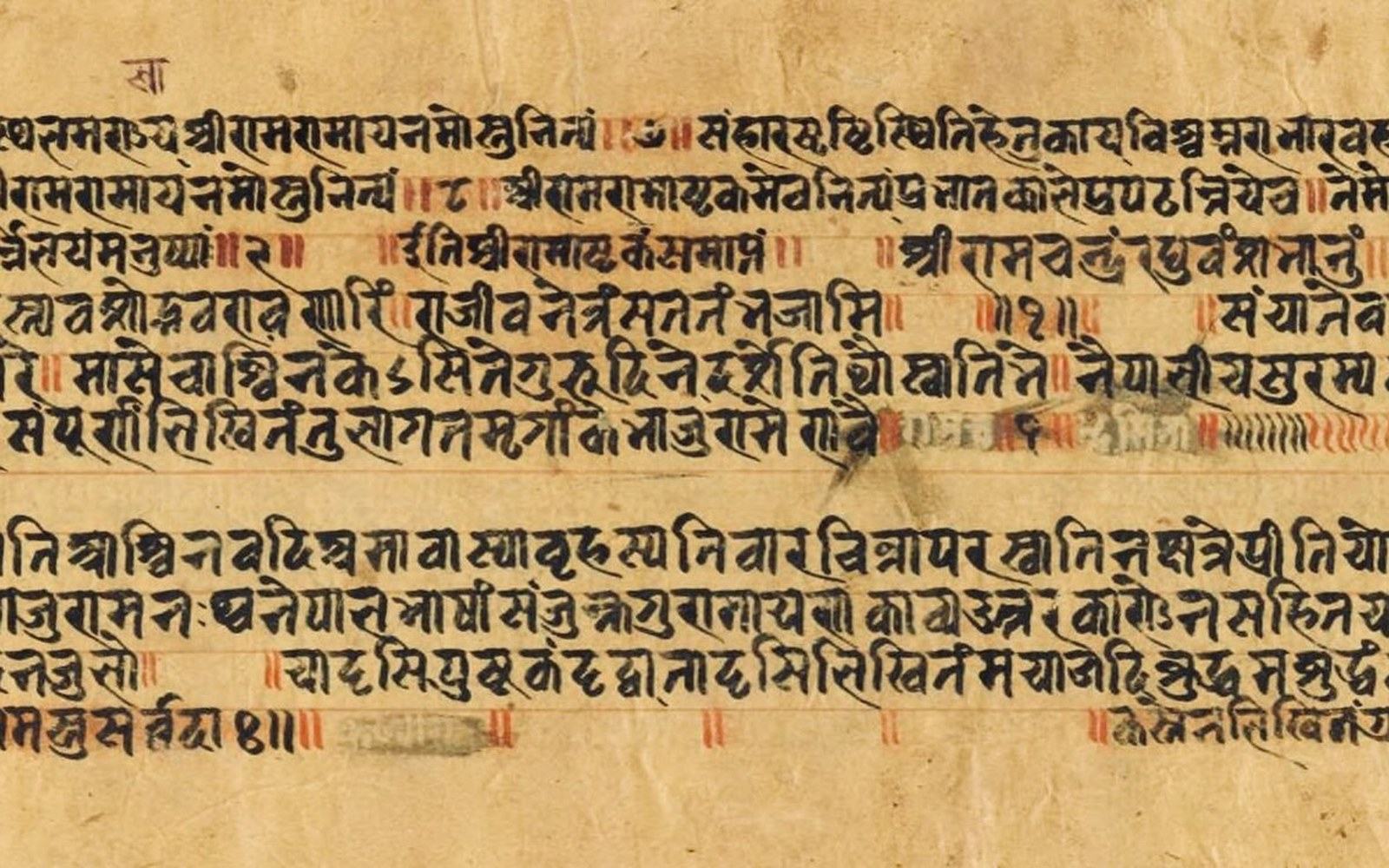
The stroke is called a śirorekha — literally "head-line" — and it is not decoration. In well-drawn Devanagari, the śirorekha of adjacent letters joins into a single continuous bar that runs the length of the word, giving the script its characteristic suspended-from-a-rail appearance. Print a word in a Latin typeface and you can, at the crudest level, drop each glyph beside the next and achieve something legible. Attempt the same with Devanagari and you get a broken comb: individual cap-lines that refuse to meet, gaps at every junction, a word that looks as though it has been typeset by someone who has never seen the script. The śirorekha must be shared across the word, not replicated per letter, and that is an instruction no simple left-to-right advance-width calculation can carry.
The problem becomes structural the moment two consonants sit adjacent without an intervening vowel. Sanskrit, Hindi and Marathi all permit extended consonant clusters, and the correct rendering is a conjunct — a single fused or stacked glyph for two or more consonants — not two separate letters with a visible boundary between them. The conjunct form may bear no visual resemblance to either of its component letters; it is a distinct drawing that the font must contain and that the rendering layer must know when to invoke. Nothing in the encoding of a code point tells you which glyph to draw; that decision happens at a separate layer, between the stored text and the screen.

What the shaping layer actually does
The layer in question is a shaping engine: software that reads a run of Unicode code points, consults the font's internal tables, and emits a positioned sequence of glyph identifiers — not characters, glyphs — together with the metric adjustments that place each one correctly. The Unicode Standard assigns code points to Devanagari letters but explicitly defers the question of how to render them; the OpenType specification, maintained by Microsoft, is where the rendering logic for the script is formally described, mapping the sequence of Unicode inputs onto the sequence of lookup operations the font must respond to.
The process for a single Devanagari syllable involves several ordered passes. First, the engine identifies syllable boundaries — a consonant cluster followed by a matra (a dependent vowel sign) and any combining marks. It then applies a canonical reordering: the reph, the above-base form of the consonant RA, is stored in logical sequence before its consonant (RA + halant + consonant) but must appear visually above the entire syllable, so it is repositioned before rendering. Similarly, a matra typed and stored to the right of its consonant may need to be placed to the left in the visual output. These reorderings are not corrections; they are the designed behaviour of the script, and the shaping engine is where they are enforced.
Chronology
- 1988ISCII first published by Bureau of Indian Standards
- 1991ISCII revised (IS 13194:1991), the version Unicode encoding referenced
- Early 2000sKerala, Tamil Nadu state deployments specify Indic rendering requirements in tenders
- 2006 onwardsHarfBuzz development consolidates Indic shaping in a single open-source library
After reordering, the engine applies ligature lookups. A consonant followed by a halant (the virama, the sign that suppresses the inherent vowel) signals to the engine that the following consonant should be checked for a conjunct pair. If the font contains a precomposed glyph for that pair, the engine substitutes it. If it does not, the engine falls back to a half-form — a curtailed version of the first consonant — or, at last resort, places the halant visibly between the two letters. The quality of the fallback hierarchy is where good Devanagari fonts separate themselves from poor ones, and it is why the first faces most systems shipped were scrutinised so closely by language engineers.
Finally, anchor-based mark positioning places any above- or below-base marks — the anusvara, the visarga, vowel signs — at defined attachment points on the base glyph, not at a fixed vertical offset. This is the step that makes diacritics sit correctly regardless of which base letter they are attached to, and it requires both the engine and the font to agree on a coordinate system.
The problem becomes structural the moment two consonants sit adjacent without an intervening vowel.
The ISCII inheritance and what Unicode carried forward
The Devanagari Unicode block, running from U+0900 to U+097F, was not designed from scratch. The Bureau of Indian Standards' ISCII standard, published in 1988 and revised in 1991, had already established a byte-level encoding for ten Brahmi-derived scripts on a single table, and the Unicode block's internal ordering reflects that inheritance. ISCII 1991 arranged vowels, consonants, matras and combining signs in a sequence that was script-logical rather than glyph-logical, which is exactly what Unicode also chose. The shaping engine must therefore do the same work whether it is processing ISCII-converted text or fresh Unicode input: the storage order is phonological, the display order is visual, and bridging them is the engine's entire purpose.
The consequence for procurement was real and documented. When Kerala and Tamil Nadu began deploying Linux-based systems in government offices and schools through the early 2000s, the tenders specified font rendering requirements that implicitly demanded a conformant shaping engine. HarfBuzz, the open-source shaping library now used across virtually every Linux distribution, implements the OpenType shaping specification including the Devanagari, Tamil, Malayalam and nine other Indic script models. C-DAC's BOSS (Bharat Operating System Solutions) distribution bundled HarfBuzz and a set of Indic fonts as core components, because a system that could store Devanagari text but not render its conjuncts correctly was not a usable government workstation. The BOSS distribution's technical documentation records the font and rendering stack choices that were made to meet those requirements.
Why the layer cannot be skipped
There is sometimes a temptation, in minimal embedded systems or early terminal implementations, to sidestep shaping and display Devanagari as individual encoded forms. The result is always the same: broken śirorekha lines, unresolved conjuncts displayed as two letters with a visible halant between them, and matras displaced from their bases. A native reader identifies the text as malformed immediately, not as a degraded-but-legible fallback. For scripts where conjuncts and reordering carry phonological meaning, incorrect rendering does not merely look wrong — it can produce a different word entirely.
The śirorekha, then, is not an aesthetic preference. It is a constraint that the script encodes at the level of design, that the encoding standard defers, and that only a correctly implemented shaping engine can honour. Every Devanagari word on a Linux desktop in India has passed through that layer, invisibly, before it reached the screen.
The terms it turns on
- śirorekhathe horizontal head-line joining Devanagari letters across a word
- conjuncta fused glyph for two or more consonants without an intervening vowel
- rephthe above-base form of the consonant RA, repositioned by the shaping engine
- halant / viramathe sign suppressing a consonant's inherent vowel; triggers conjunct lookup
- matraa dependent vowel sign; may render to the left of the consonant it follows in storage
- HarfBuzzthe open-source shaping library implementing OpenType Indic models